

This review contains affiliate links. If you buy through them I earn a commission at no extra cost to you. Full disclosure.
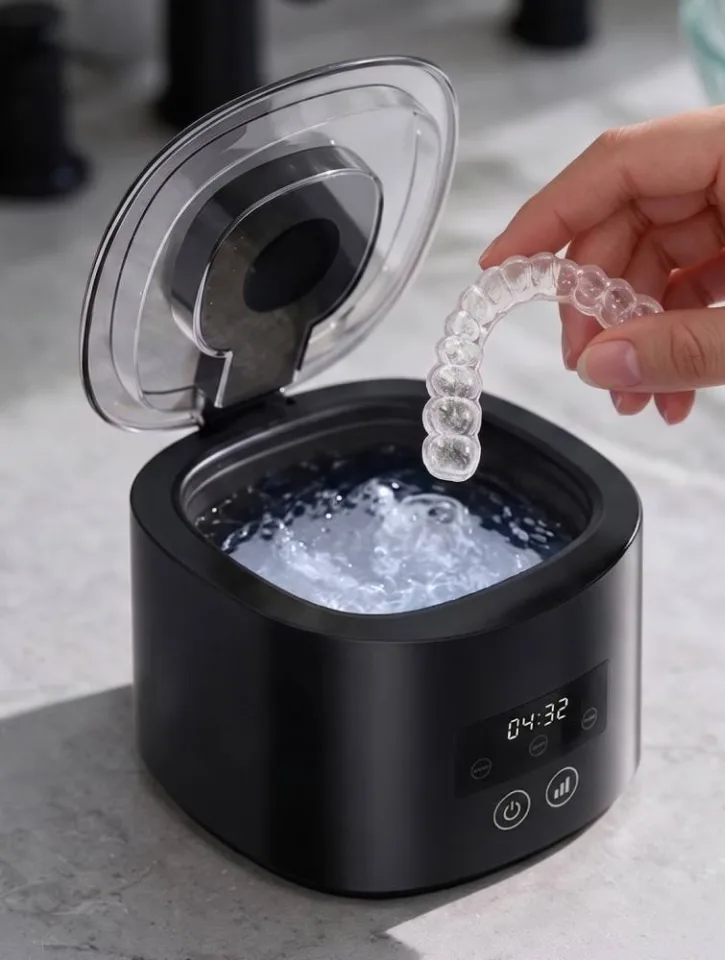
DentaSonic is a cordless ultrasonic retainer cleaner: a small stainless steel tank that shakes buildup off retainers, aligners, night guards, and dentures in 3, 5, or 10 minutes. The hardware is well specified. Just don’t run it on plain water every time, and I’ll show you the research behind that.
- Good fit if you: wear a retainer, aligners, a night guard, or dentures every day and you’re tired of scrubbing grooves a toothbrush can’t reach.
- Skip it if you: want something that disinfects with water alone, or you’d rather try it first and send it back used.
Ships worldwide · one-time purchase · official site only
Heads up: this is a specs-and-research review, and I’m not a dentist. Follow the care instructions from whoever made your appliance.
Is DentaSonic worth it? If you clean a retainer, aligner, or night guard daily, yes. It’s a 47 kHz ultrasonic retainer cleaner with three timed cycles and a battery that lasts about 50 quick cleans. The research on ultrasonic cleaning is good, with one catch: results are better with a cleanser in the water than with water alone.
Most DentaSonic reviews repeat the sales page. This one checks the specs against the published studies, reads the return policy, and lists the real checkout prices.
Quick facts
| DentaSonic at a glance | |
|---|---|
| What it is | Cordless ultrasonic retainer cleaner (ultrasonic bath) |
| Frequency | 47 kHz |
| Cycles | 3-minute Quick Clean, 5-minute Enhanced Clean, 10-minute Deep Clean |
| Tank | 180 ml, stainless steel |
| Power | USB-rechargeable, up to 150 minutes per charge (about 50 quick cycles). It won’t run while charging. |
| Weight | 320 g, about 0.7 lb |
| Cleans | Retainers, clear aligners, mouthguards, night guards, dentures, small jewelry |
| UV light | No |
| Price | $69.90 for one, down to $40.55 each in a four-pack, plus shipping |
| Returns | 30 days from delivery. Change-of-mind returns must be unused. |
| Where to buy | Official website |
| My rating | 4.1 / 5 |
Pros and cons
What I liked
- Three timed cycles instead of one fixed timer
- Cordless, with a battery rated for about 50 quick cleans
- Stainless steel tank instead of a plastic cup
- One device for the whole household’s appliances, and it’s light enough to travel with
What I didn’t
- The “removes 99% of bacteria” claim comes with no test I could find
- Sold as “plain water only”, when the research favors adding a cleanser
- You can’t run a cycle while it’s plugged in
- A change-of-mind return only works if the unit is unused
What is DentaSonic?
DentaSonic is an ultrasonic retainer cleaner. You fill the tank with water, drop your appliance in, and press one button. The machine vibrates the water at 47 kHz, which forms tiny bubbles that collapse against the surface and knock loose the film a toothbrush skates over.
That film is the whole problem with removable appliances. A clear retainer has fitted grooves. A Hawley retainer has a wire. A night guard has a bite surface full of tiny pits.
Bristles reach some of it, and the rest turns cloudy and starts to smell.
Dental offices have cleaned instruments and appliances in ultrasonic baths for decades, so the method itself isn’t a gimmick. DentaSonic is a small countertop version of the same idea.
Does DentaSonic work with just water?
It runs on plain water, and the maker says that’s all routine cleaning needs. The published research says water alone is the weakest way to use any ultrasonic retainer cleaner. This is the most useful thing I can tell you before you buy one.
A 2026 clinical study on clear retainers had patients clean four ways for 14 nights each. Ultrasonic cleaning with an antibacterial mouthwash in the tank left the least contamination of all four. Ultrasonic cleaning with plain water left the most, behind even brushing with toothpaste.
An earlier study on aligners compared nine cleaning routines under an electron microscope. Only one clearly removed the bacterial film: five minutes of ultrasonic cleaning with a cleaning solution. And a 2025 review of ten denture trials found ultrasonic cleaning reduced plaque and microbes, “particularly” when paired with a fizzing cleanser tablet.
So here’s how I’d use it. Run the 3-minute cycle on water for the daily rinse, and add a retainer or denture cleaning tablet a few times a week.
The machine does the scrubbing you can’t. The cleanser does the killing. Check your appliance’s care sheet first, because some makers rule out certain cleansers.
The specs, and what they mean on a bathroom counter
47 kHz. Most small ultrasonic cleaners sit somewhere in the 40s. The maker says rivals run at 42 to 45 kHz, which I can’t check across every model. What I can say is that the aligner study above got its result at 42 kHz, so 47 is in the range that has evidence behind it.
Three cycles. This is the feature I’d pay for. Three minutes fits inside the time you spend brushing your teeth.
Five is for the week you got lazy. Ten is for the night guard that sat in its case over a long weekend.
180 ml stainless steel tank. That’s about three quarters of a cup of water. Stainless steel is also easier to rinse clean than a plastic soaking cup.
150 minutes of battery. Fifty quick cycles is seven weeks of daily use between charges. The trade-off: it charges by USB and won’t run plugged in, so a dead battery means you wait.
No UV light. Some cleaners add a UV lamp. DentaSonic doesn’t, and the maker’s reasoning is fair: light only disinfects the surface it reaches, and it doesn’t lift film off. I wouldn’t treat the missing lamp as a loss.
How to use DentaSonic
The maker’s instructions are three steps. Fill the tank with water. Set your retainer, aligner, mouthguard, or denture inside. Press the control to pick 3, 5, or 10 minutes.
Two additions from me. Rinse the appliance under the tap first, so loose debris doesn’t cloud the tank. And empty and dry the tank after each run, because standing water is exactly what you bought this to get away from.
Is it safe for Invisalign, retainers, and night guards?
The maker lists retainers, clear aligners, mouthguards, night guards, and dentures, and tells you to check your appliance’s own care guidance for restrictions. That’s the right order of authority. Your orthodontist’s sheet outranks any cleaner’s marketing.
The retainer study I cited also measured what two weeks of nightly ultrasonic cleaning did to the plastic. Color, surface roughness, and hardness didn’t change in any meaningful way.
One thing ultrasonic cleaning won’t do is bleach out old stains. A 2026 lab study found it added nothing to stain removal on aligner material. It keeps a clean retainer clean. It doesn’t rescue a yellow one.
If your appliance is already stained, that’s a separate question, and I cover the whitening side in my guide to whitening with braces, retainers, and veneers.
Who should actually buy it
Buy it if you wear something removable every single day. That’s the person who gets the value: 365 cleans a year, no scrubbing, and nothing soaking on the counter for hours.
It makes the most sense in a house with more than one appliance. A teenager’s retainer, a parent’s night guard, a grandparent’s partial. That’s also where the two-pack earns its discount, one for each bathroom.
Don’t buy it as a disinfecting machine. It’s a cleaning machine, and a good-looking one on paper.
DentaSonic price, shipping & where to buy
DentaSonic is sold on the official website. I read these prices off the US checkout on October 12, 2026. They can change, so confirm on the official page before you order.
| Package | Price each | Shipping | Total |
|---|---|---|---|
| 1 DentaSonic | $69.90 | $4.95 | $74.85 |
| 2 DentaSonic | $56.00 | $5.95 | $117.95 |
| 3 DentaSonic | $46.40 | $6.95 | $146.15 |
| 4 DentaSonic | $40.55 | $7.95 | $170.15 |
It’s a one-time purchase. I saw no subscription and no warranty add-on pre-ticked at checkout, which I always look for. The second unit drops the price by about $14 each, so two for a two-appliance household is the sensible step.
Shipping is worldwide. The maker’s estimates are 2 to 12 business days in the United States, 7 to 12 in the United Kingdom, 8 to 12 in Canada, and 8 to 14 in Australia and New Zealand.
Ships worldwide · one-time purchase · official site only
The verdict
4.1 out of 5. DentaSonic gets the hardware right: a frequency in the range the research used, three cycle lengths, a steel tank, and a battery that outlasts a long trip. For anyone cleaning a retainer or night guard every day, that’s a real upgrade over a toothbrush and a cup.
It loses a point for marketing. “Removes 99% of bacteria” has no test attached, and “no tablets needed” is true of the machine but not of the best result. Use it the way the studies did, with a cleanser in the water a few times a week, and it does the job it’s built for.
Returns: read this before you order
The sales page says “100% Satisfaction Guarantee”. The written policy is more specific, and it’s the one that counts. You have 30 days from delivery. A damaged, defective, or wrong item gets a replacement or a full refund.
A change-of-mind return is different. The unit has to be unused and in its original packaging, you need approval before sending it, and you pay the return shipping. In plain terms: decide before you run the first cycle. Keep your order confirmation and the box.
Frequently asked questions
Does DentaSonic really work?
Ultrasonic cleaning is a proven way to remove film from dental appliances, and DentaSonic’s 47 kHz sits in the range the published studies used. Expect it to lift cloudy buildup from grooves and wires a brush can’t reach. Expect better results with a cleanser in the water than with plain water.
Is DentaSonic legit?
Yes. It’s a real product with a listed US company at checkout, a phone number, and written shipping and return policies. The specs are concrete and checkable. The one claim I’d take loosely is “removes 99% of bacteria”, since the page doesn’t cite a test for it.
Do I need cleaning tablets with DentaSonic?
The machine runs on plain water and the maker says tablets aren’t required. The research points the other way for a deep clean: in clinical studies, ultrasonic cleaning worked best with a cleanser in the tank. I’d use water daily and add a retainer or denture tablet a few times a week.
Does DentaSonic kill bacteria?
It removes the film bacteria live in, which is most of the job. The maker claims 99% of bacteria and dirt, but I couldn’t find the test behind that number. In a 2026 retainer study, ultrasonic cleaning with water alone left more contamination than ultrasonic cleaning with an antibacterial mouthwash.
Is DentaSonic safe for Invisalign and clear retainers?
Clear aligners and retainers are on the maker’s list of supported appliances. A 2026 clinical study found two weeks of nightly household ultrasonic cleaning didn’t change the color, roughness, or hardness of clear retainer plastic. Check the care instructions that came with your own appliance first.
How much does DentaSonic cost?
On October 12, 2026 the US checkout showed $69.90 for one unit plus $4.95 shipping. Multi-packs drop the unit price: $56.00 each for two, $46.40 each for three, and $40.55 each for four. Prices can change, so check the official page.
How long does a DentaSonic cleaning cycle take?
You choose 3, 5, or 10 minutes. The maker suggests the 3-minute Quick Clean for daily use, the 5-minute Enhanced Clean when buildup is visible, and the 10-minute Deep Clean after an appliance has sat in its case.
Is an ultrasonic retainer cleaner better than tablets?
They do different jobs, and the studies favor using both. Ultrasound shakes film loose from places a brush can’t reach. A tablet does the chemical cleaning. A 2025 review of ten denture trials found ultrasonic cleaning worked best when it was paired with a cleanser.
Is DentaSonic the same as DentaSonic Pro?
The official web address includes “dentasonicpro”, but the product on the page and at checkout is simply called DentaSonic, and I found one model. It’s also unrelated to the Rowenta Dentasonic toothbrush and the DentaSonic IPR tool dentists use, which happen to share the name.
What’s the DentaSonic return policy?
You have 30 days from delivery. Damaged, defective, or wrong items get a replacement or full refund. If you simply change your mind, the unit must be unused and in original packaging, the return has to be approved first, and return shipping is on you.
This article is for informational purposes only and is based on the manufacturer’s published specifications and independent research. It is not medical or dental advice and doesn’t replace professional care. Follow your dentist’s or orthodontist’s instructions for cleaning your appliance.