

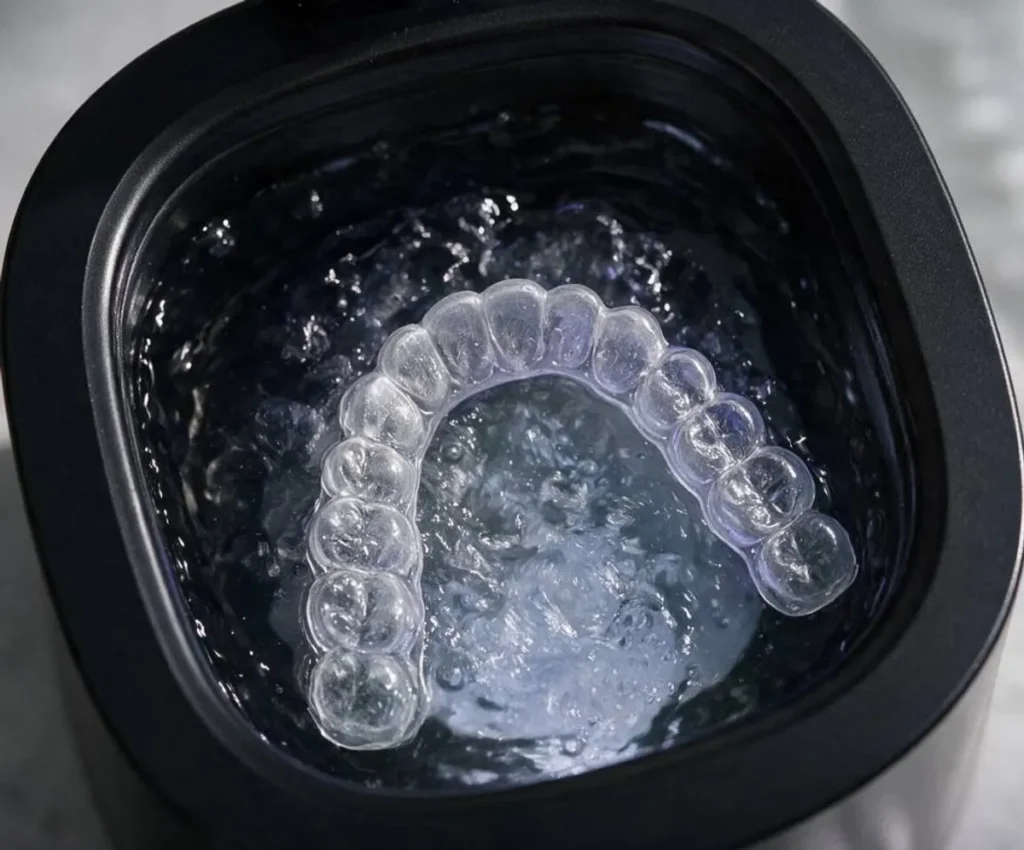
Do ultrasonic retainer cleaners work? Yes. Clinical studies show ultrasonic cleaning removes the film on retainers, aligners, and dentures that a toothbrush misses. The catch is what’s in the tank: with plain water the results are weak, and with a cleaning tablet or solution, ultrasonic cleaning comes out on top.
I went looking for the research because the marketing in this category all says the same thing: add water, press a button, 99% of bacteria gone. The studies tell a more useful story, and it changes how you should use one.
How an ultrasonic retainer cleaner works
An ultrasonic retainer cleaner is a small tank that vibrates water at around 40 to 50 kHz. The vibration forms microscopic bubbles that collapse against whatever is in the tank. Each collapse is a tiny scrub.
That matters for appliances because of their shape. A clear retainer has fitted grooves, a Hawley has a wire, and a night guard has a pitted bite surface. Bristles can’t get into all of it. Moving water can.
Do ultrasonic retainer cleaners work with just water?
Not well. A 2026 clinical study had 11 orthodontic patients clean clear retainers four different ways, 14 nights per method. The researchers then measured how much microbial contamination was left.
| Cleaning method | Contamination left (1 = least) |
|---|---|
| Ultrasonic cleaner with antibacterial mouthwash in the tank | 1 |
| Brushing with an antibacterial (chlorhexidine) product | 2 |
| Brushing with fluoride toothpaste | 3 |
| Ultrasonic cleaner with plain water | 4 |
Same machine, first place and last place. The only difference was what went in the water. The mouthwash in that study was a chlorhexidine rinse, the kind dentists prescribe, so ask yours before copying it at home.
Do ultrasonic retainer cleaners need tablets or solution?
The machine doesn’t need them to run. Your retainer needs them to get properly clean. That’s the plain reading of the evidence.
An aligner study compared nine cleaning routines under an electron microscope. Only one clearly removed the bacterial film: five minutes of ultrasonic cleaning at 42 kHz with a cleaning solution. Rinsing with water alone did worst.
A 2025 review of ten randomized denture trials landed in the same place. Ultrasonic cleaning reduced plaque and microbes, particularly when it was combined with a fizzing cleanser tablet. The authors also noted the trials weren’t perfect, so treat this as good evidence, not final proof.
Our pick
DentaSonic is the ultrasonic retainer cleaner I’d pick. It runs at 47 kHz with three timed cycles (3, 5, and 10 minutes), has a stainless steel tank, and is cordless, with a battery rated for about 50 quick cleans. Use it with a cleaning tablet a few times a week, the way the studies did, not on water alone every time.
Ships worldwide · one-time purchase · official site only
Want the details first? Read my full DentaSonic review. This is an affiliate link, and here is how that works.
Do ultrasonic retainer cleaners kill bacteria?
They mostly remove bacteria instead of killing them. Ultrasound shakes loose the film bacteria live in, and the film goes down the drain when you empty the tank. That’s most of the job.
The killing comes from chemistry: a tablet, a cleaning solution, or a rinse your dentist approves. So when a product page says “removes 99% of bacteria” with nothing but water, ask where the test is. I haven’t found one attached to that number.
Do ultrasonic retainer cleaners damage retainers?
The evidence says no. The 2026 retainer study measured the plastic after two weeks of nightly cleaning. Color, surface roughness, and hardness showed no significant change with any of the four methods, ultrasonic included.
Your appliance’s own care sheet still comes first. Some makers rule out hot water or particular cleansers, and that guidance outranks anything a cleaner’s box says.
Ultrasonic retainer cleaner vs tablets
This is usually framed as a choice. It isn’t.
Tablets do the chemical cleaning but leave film sitting in the grooves. Ultrasound clears the grooves but doesn’t disinfect much with water alone. Together they cover each other’s gap.
There’s one thing neither does well. A 2026 lab study stained aligner material with coffee and found ultrasonic cleaning added nothing to stain removal. It keeps a clean retainer clean. It won’t turn a yellow one clear again.
Are ultrasonic retainer cleaners worth it?
If you wear a retainer, aligners, a night guard, or dentures every day, yes. You’ll use it 365 times a year, it takes three minutes, and it reaches what your brush can’t. Few bathroom gadgets get used that often.
If you wear a retainer two nights a week, a toothbrush and a tablet will do. I’d rather tell you that than sell you a machine that lives in a drawer.
How to use an ultrasonic retainer cleaner
Rinse the appliance under the tap first. Fill the tank with cool or lukewarm water and add a cleaning tablet if it’s a deep-clean day. Run a 3 to 5 minute cycle, rinse the appliance again, then empty and dry the tank.
That last step is the one people skip. Standing water in a closed tank is the same problem as a wet retainer case.
Ships worldwide · one-time purchase · official site only
Frequently asked questions
Do ultrasonic retainer cleaners really work?
Yes, when there’s a cleanser in the water. In clinical studies, ultrasonic cleaning with a cleaning solution removed more film and microbes than brushing. With plain water it removed less than brushing with toothpaste. The machine provides the scrubbing, and the cleanser provides the disinfecting.
Do ultrasonic retainer cleaners work better than tablets?
They work better with tablets than instead of them. A 2025 review of ten randomized denture trials found ultrasonic cleaning reduced plaque and microbes most when combined with a fizzing cleanser. Tablets alone leave film in the grooves, and ultrasound alone doesn’t disinfect much.
Are ultrasonic retainer cleaners safe for Invisalign?
A 2026 clinical study on clear retainer plastic found no meaningful change in color, roughness, or hardness after two weeks of nightly household ultrasonic cleaning. Check the care instructions from your aligner provider first, since they can restrict water temperature or specific cleansers.
Do ultrasonic retainer cleaners remove stains?
Not much. A 2026 lab study on coffee-stained aligner material found ultrasonic cleaning didn’t improve stain removal. How clear the plastic came back depended on the cleaning agent, not the ultrasound. Daily cleaning prevents the buildup that stains in the first place.
Can you use an ultrasonic retainer cleaner for a night guard or dentures?
Yes. The strongest evidence for ultrasonic cleaning is actually on dentures, where ten randomized trials found it reduced plaque and microbes. Night guards have the same kind of pitted surface, so I’d expect the same benefit, though I haven’t seen a trial on night guards specifically. Use a cleanser made for the appliance you have.
This article is for informational purposes only and reflects my own reading of the published research. It is not medical or dental advice and doesn’t replace professional care. Follow your dentist’s or orthodontist’s instructions for cleaning your appliance.